A few years back I wrote about the nature of classic albums, past and present. But on this occasion I'm thinking about them a bit differently.
One of the most interesting phenomenons in modern popular music is that virtually every act who sold millions of records in the 70s had a huge creative lull in the 80s. Surely it isn't as simple as artists suddenly becoming dinosaurs who couldn't adjust to new technology or business models. Is there any decade to decade transition in the last century that compares to the marked decline in quality of commercial music like the 70s to the 80s? There is no simple answer. Of course there was still much great music in the 80s, but most of it wasn't seen on MTV. Of course it can be argued that artists of any era tend to have a creative peak that only lasts a few years, but something else is at work here.
The business had changed in many ways. FM radio went from album oriented radio to playlists in the late 70s, as it was becoming clear that a bigger audience meant higher advertising revenues. With hits now being on both AM and FM radio, albums became progressively less marketable. When there's no need to make an album like you used to, the product becomes less cohesive, not to mention the pressure to create a hit song takes its toll. Almost all successful artists of the 70s did not make the transition into the 80s well. People like Peter Gabriel were the exception to the rule (incidentally, he was flat broke by 1982).
There were other factors. With the advent of things like video games and creating your own mix tapes, people were spending less money on LPs by the late 70s. For the previous decade, LPs were what most teenagers and adults spent most of their disposable income on. People had prided themselves on their record collections. It was an extension of who they were. Artists knew this. The focus was on creating the great album, not the hit single. The lead single was selected after the album was finished. But with FM radio's change in business plan and record companies following suit, this would no longer be the case.
They say things move quickly now - just look at how much the nature of popular music changed between 1975 and 1980. You can bet your life that Queen wouldn't have gotten a record deal with A Night At The Opera in 1980. Zeppelin would've been thrown out of the record exec's office with Physical Graffiti. Pink Floyd's Wish You Were Here starting with a 13 minute song? Forget about it.
"What do you mean it's not marketable? Of course you can make a music video with Dionysus and the marble white. Place them right beside the hearts of men despaired."
There was no comparable seismic shift in any art form until YouTube came along. Today we expect things to change quickly, but in the 70s people really thought the LP would last forever, and along with that, music on the radio that would continue to be new and exciting and more interesting than the previous year. It was the format that drove artists to be great, with the added bonus of new territory to be found as the technology grew.
A ton of good music has been produced since then and will continue to be produced, but so much has changed in the way the business interferes with the process of its creation when its target is mainstream audiences. Articles like this are more revealing than most people would ever want to realize, and I feel like the Grinch for even mentioning it. But this is not a new phenomenon. Motown had already become a musical assembly line by the mid-60s, but most other branches of popular music were about to enjoy a period of unparalleled creativity untampered with by the powers that be. Additionally, any number of artists or record label employees in the late 60s and early 70s would tell you that more revenues were pumped into artist development during that period than ever.
Music is not consumed the way it was consumed 40 years ago, either. The world is a much different place, not least because there is so much music available and it has become so disposable in the form of downloaded files, as opposed to a physical piece with liner notes and artwork that you stared into while listening to the music and doing literally nothing else for 45 minutes after proudly carrying it home without a plastic bag as if it were a badge of honour, your statement to the world of what's important to you. But nothing lasts forever.
Artists like Bob Dylan, The Beatles, The Doors, Supertramp, Joni Mitchell, and Stevie Wonder truly were a product of their time. 1966-1976 was a magical period to create popular music, and such an environment and canvas will probably never be seen again.
Last night Black Sabbath's "The End" tour hit First Ontario Centre in Hamilton, appropriately named for the legendary band's final road trip across much of the globe.
Support act Rival Sons opened the festivities. The Long Beach, California band's influences almost exclusively lie in 70s rock, making them sound derivative at times, but there were many moments of excellence, particularly in an extended version of the ballad Where I've Been, where guitarist Scott Holiday offered a soulful solo not heard on the studio version. Singer Jay Buchanan worked hard to win the audience over, and genuinely stated numerous times their pleasure of being the last band to open for Black Sabbath. For this audience of predominantly 60-somethings, they were exactly the right choice.
The main dish hit the stage a bit before 9pm, with a dazzling video display that eventually revealed the band's logo, leaving the audience mesmerized before even playing a note. They soon launched into the title track from their 1970 eponymous album, and the faithful in attendance sang along to every word.
Within a couple songs, it became quickly apparent that it would be an uneven performance from Ozzy Osbourne. Several gigs earlier in the tour were cancelled with the frontman having a bout of sinusitis, but it wasn't a case of him being unable to sing. Even though most of the songs were tuned a whole step down, Ozzy sung flat for much of the night, varying from song to song. The front of house sound technician wisely adjusted the frontman's fader to have him a bit lower in the mix than a lead vocal should be, so that his flaws wouldn't be as apparent.
But there's no hiding from it on video:
"Fairies wear boots, and I don't wear in-ears." -- Ozzy Osbourne {{citation needed}}
In the world of opera music, for example, audience reaction to such proceedings would range from utter disbelief to seeking a refund, but classic rock crowds generally aren't as discerning. If they cheered after every song Led Zeppelin played in 1977 when 100-pound Jimmy Page (on a diet of little more than groupies and smack) was barely able to play on some nights, then they were going to love every minute of this grand event, shortcomings notwithstanding. With the ever-familiar concert smells in the air, not only does this iconic singer know he can get away with a lackluster vocal performance, every sentence of Ozzy's banter can contain the F-bomb with impunity. Being an orator is not in the job description, either.
But he still did have his great moments, like his call and response with the audience in War Pigs. Being in the middle of a crowd singing the soaring melodies at
the end of the Nixon era anti-authoritarian war protest anthem is one of the great concert experiences any rock fan
can have, not unlike Hey Jude at a Paul McCartney concert. It is the
same common denominator of bringing people together. And it was extra special this time, knowing it
was the last time.
His movements on stage were classic Ozzy at all times, often prompting the audience to sway their arms during most mid-tempo passages, for example. But he was the one weak link in an otherwise flawless show. Visually and aurally, it was everything a farewell concert should be. Stock footage of the band in their heyday was used at the right moments, and the vibe was one of celebration of music that not only defined a genre, but created one. The setlist reflected exactly what their audience wanted to hear; all but three songs were from their first three albums. Their next three long players (particularly 1975's Sabotage) showed a great sense of musical maturity, but it was their self-titled debut, Paranoid, and Master Of Reality that pioneered what is now called doom metal.
Guitarist Tony Iommi and bassist Geezer Butler were completely on their game, executing their parts with a surgeon's precision, replicating the album cuts to perfection. Filling in for Bill Ward, drummer Tommy Clufetos was a faithful servant to the music, and his solo spot in Rat Salad was a show highlight. For flare and presentation he gets a 10/10, but it was the polar opposite of someone like Neil Peart of Rush who turns a drum solo into the musical equivalent of a Shakespearean play, complete with plot twists, births, deaths, and an exquisite combination of mainstay sections and forays into the unknown. Clufetos, by contrast, simply offered sheer intensity and power, finally finishing with an ostinato kick drum signalling the beginning of Iron Man, a very effective way of building to one of the many peaks of the evening.
Utility outfielder Adam Wakeman (son of Yes legend Rick Wakeman) added some keyboard and guitar from backstage, but was only really in the sound mix on a couple occasions, notably not in Dirty Women, which should have a pretty vital organ part.
The plus side of the songs being tuned lower was that their sound became even more dark and mysterious. The main guitar riffs in N.I.B. and Into The Void sounded like pure Satan, just as the doctor ordered back in 1971.
The last song of the set proper, Children Of The Grave, was the only one to be performed in the original key, which is actually tuned down a step and a half on the album. The band left the stage, with Ozzy sounding tacky as ever while guiding the audience in a "one more song!" chant. They finished with the staple Paranoid, and the otherwise stoic Iommi cracked a smile towards the end. He may not have been quite as pleased thirty seconds later, though, as Osbourne forgot the lyrics of the entire last verse, despite having a teleprompter at his disposal.
The fans couldn't have cared less. Black Sabbath were bidding their farewell, and respect for the music and its creators was all that mattered in the end.
Rolling Stone had ceased to
recognize the mere existence of progressive rock until literally last year, where Rush were finally given their first cover story after Britney Spears had her
seventh. And now they're actually writing about a current band in the
genre (the article
is well worth the read). Dream Theater has existed for over 25 years,
more or less innovated a genre of music (progressive metal), and sold
ten million records without a hit single. Love them or hate them, they
have an audience; a dedicated and passionate one that will fill up
theatres anywhere in North and South America, and arenas in Europe
and Japan - a feat that few artists have ever achieved.
Their
strongest albums are almost indisputably Images And Words and Scenes
From A Memory. But lately their biggest flaw has been their almost
constant need to put their technical
ability before good songwriting, lately to the point that they've almost
become a parody of themselves. I've always thought that they could use
some healthy outside interference, kind of like Rush did ten years ago
with Nick Raskulinecz. Enter veteran producer David Campbell, whose CV
that includes Michael Jackson, Adele, Justin Timberlake, and Muse would
make your computer crash.
After a couple listens of The Astonishing, above all else I hear a band bravely making a huge
departure from their sound with mixed results - but mostly good. The
concept is king, and the technical wankery is restricted to a minimum,
as it's always complimentary to the story. Refreshing.
For
the first time, singer James LaBrie is the star on a Dream Theater
album, with keyboardist Jordan Rudess a close second. LaBrie sings all
eight characters in the story convincingly, and perhaps for the first
time, Rudess displays his gifts as an arranger in full.
Also, National Geographic recently recognized his goatee to be an entire ecosystem.
John
Petrucci is more of a writer than guitar hero here (which isn't to
demean his contributions on the axe, but to highlight his compositional
abilities), bassist John Myung
holds his own as always, but drummer Mike Mangini comes across as pedestrian, which may sound unusual given his technical prowess and feel in other situations (think Extreme). His sound is so processed and artificial that it almost sounds like a drum machine. This is my only major gripe with the album.
At their best, Dream Theater are
remarkable at what they do, which leaves me all the more sad that Mike
Portnoy isn't on it. Now estranged from his bandmates of 20
years, his playing has a balance of technicality and personality more than pretty well any living
rock drummer, with the possible exception of Danny Carey or Neil Peart.
At
over two hours long, this album is unlikely to draw hoards of new fans
to the
Dream Theater fold. But it may finally make people realize that
there's far more to this band than long songs where guys play fast.
This is the exact opposite. There are thirty-four tracks, and none
over eight minutes in length. There is depth in the storytelling,
ultimately making this a great example of a 21st century rock opera. It
may not rival Tommy or The Wall, but if you're into
progressive rock and willing to invest the time, you'll very likely find
it to be a
rewarding listen.
However, like so many double albums, some listeners may find themselves wondering how much stronger it would've been as a single album with a dozen less tracks (people have even said this about the White Album, never mind a Dream Theater album). There are many hooky songs here (like The Gift Of Music and The Beginning), but they may get lost amidst the many ballads.
So I'm not sure if it can be called "Astonishing". But it is still very good.
3 1/2 out of 5 stars - their strongest outing since 2009's Black Clouds And Silver Linings. But their best days are likely behind them. Albums like Images And Words and Awake are scenes from a memory (see what I did there?).
Tonight the prestigious Massey Hall welcomed a masterful double bill of Owen Pallett and Tanya Tagaq. These Canadian artists both incorporate the violin into their acts, but that's where their similarities end. They are equally mesmerizing performers, but their methods are polar opposites from one another, yet still complementary in the span of an evening.
No need to list off Pallett's resume, as Google can do that far more effectively than I can. Suffice to say, he has worked with some of the biggest names in the business and has played on a Grammy award-winning record. As a condiment his achievements are plenty to a point that most artists would find themselves fully satisfied, but Pallett always strives for more. As the main dish he truly has his own identity. You are watching the evolution of music before your eyes.
Sonically he is a force to be reckoned with. Although he has a rhythm section accompanying him (and, on this occasion, a string quartet), he creates panoramic soundscapes on his own with his looper pedal, which he even referred to as a "party trick" before playing a couple of comparatively conventional pieces. Pallett is an intense guy, yet he ensures not to take himself too
seriously, with just enough self-deprecating commentary between songs. His 75 minute set went down extremely well.
Juno award-winning singer Tanya Tagaq began her set by introducing her band, the 60 piece choir, and its conductor. Her demeanour was that of Shirley Temple with a fire in her belly. She had the whimsical temperament of a child, speaking in such a way that we felt like we were cordially invited guests into her living room, unable to hide her excitement for her inaugural performance at Massey Hall. Her warmth was infectious, and we fell in love with her instantly. Deep down inside she surely knew that she was establishing an extreme in her informality with her banter, as the intensity of her performance would soon have her reaching the polar opposite extreme. But this is where the calculated part of the evening ends.
Known for her Inuit throat singing, the hour-long improvisation piece started more like The Rose meets Nine Inch Nails. Within a few minutes, it was reminiscent of the middle section of Led Zeppelin's Whole Lotta Love being sung by Bjork. She commanded the stage, both with her five octave vocal range and captivating movements not unlike interpretive dance.
The piece was a journey through a wide variety of moods and musical conversations between the 65 people on stage. About two thirds into the performance, the combination of her voice and mannerisms felt like an erotic battle cry.
The light show was very effective, only augmenting the experience rather than compensating for something that wasn't there. With Tagaq it's all about the aural. And it was more than music. It was a pinnacle of human expression. Unbridled spontaneous creativity at its finest.
Heard live, her music sounds almost nothing like it does on YouTube. The natural reverberation of a fine-sounding concert venue like Massey Hall creates the perfect setting for what she's trying to achieve with her art.
And the best part is - since her performances are entirely improvised, her next show will be almost nothing like this one.
Scouring the restaurants of (mostly) America sure has its advantages when you venture off the beaten path. Sometimes having the Yelp app is handy, but there's also a joy in stumbling upon something fantastic because you simply felt like walking around.
Touring with a rock band usually results in one nighters where you don't see much more than a hotel, a dressing room, a stage and a van. But when you're with a touring freak show (read: musical) and you sit in a city for a week, you're granted the freedom to explore. Unless it's a hundred degrees outside, you're not going to stay in your hotel room when there are new worlds (and foods) to be found.
This is my baker's dozen of foods I experienced in about 35 cities in North America.
13. Causa de Salmon @ Mango Peruvian Cuisine in St. Louis
The menu said - "Aji amarillo infused potato cake chilled & layered with salmon salad, sliced egg & avocado finished with red pepper aioli." Gesundheit. I took one bite, died and went to non-denominational and evidenced-based heaven, and promptly ordered something else on the menu. The item on the left is called Pascualina, which was kind of like a quiche, but not nearly as greasy.
12. Seitan Bowl @ Native Foods Cafe in Chicago
Hands down, the best vegetarian restaurant I've ever eaten at. I went three more times that week.
On the wall they had a dictionary explaining the difference between things like seitan and tempeh. Although they're both soy based, they're just as different as steak and scallops. And both delicious.
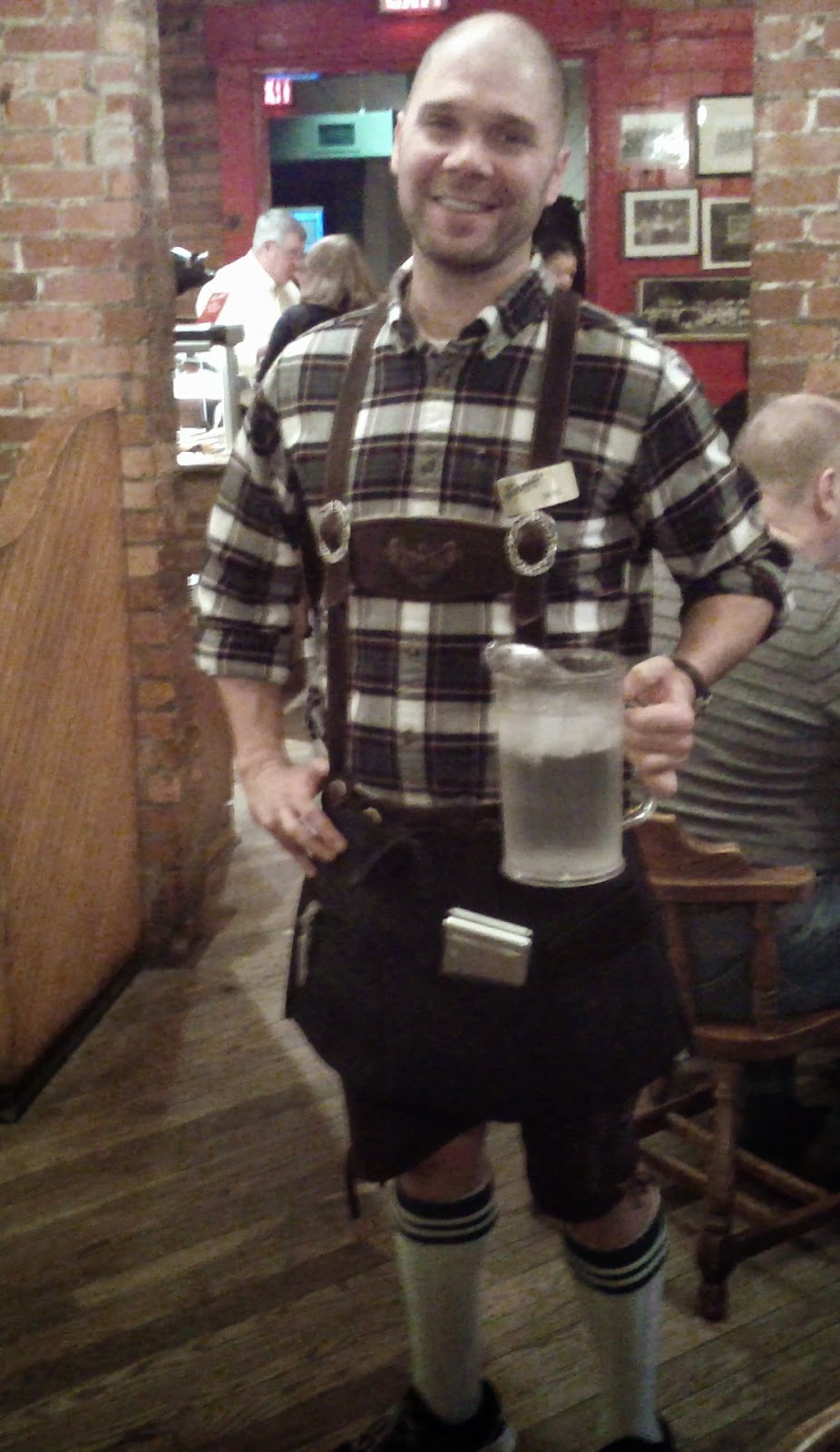
11. Schnitzel @ Schmidt's Sausage Haus in Columbus
Columbus is a very cultured city. There is a German section of town, and this place is right in the heart of it. There aren't a lot of spots to find a quality schnitzel in America, so this was a welcome surprise. The employees even dressed in Lederhosen, much to my delight.
"I'm only making $7.95 an hour. Please don't make this any more humiliating."
10. Traditional Mexican food at ... any place in Mexico
A few steps away from the hotel, we went to this place at least once a day during our two weeks in Mexico City. Just cheese, beans and chicken, but prepared in a way you can only get in Mexico.
9. Street meat at ... any place in Mexico
They make the corn tortillas right in front of you. No Tex Mex place or grocery store sells anything that remotely compares. This is the real thing, and you can only find it on the streets of Mexico. This particular stall was fortunately right next to the Auditorio Nacional, where my show had a residency for two weeks. Needless to say, I put their kids through college.
The meat on the left was the equivalent to a year being taken off your life. But it's that year at the end when nobody comes to visit you, anyway.
8. Belgian Waffle in Huatulco, Mexico
Literally a hole in the wall. There were two tables. And they served this:
The one and only moment in Mexico where I wasn't thinking about tacos.
It easily rivaled the best waffles in Europe.
7. Smoked salmon crepe @ Crepes du Nord in Bridgeport, NJ
One of the few bus trips of the tour had us stopping at this mall in New Jersey. In addition to the standard food court options, there was a stall that served crepes, only one of three locations of this small chain. The house crepe was the best crepe I've eaten in my life - smoked salmon, egg, dill sauce and chives.
The only thing that would have made this better is a building permit to bring their business to Canada. I'd even go to Buffalo for this. Yes, Buffalo.
6. Ethiopian dish in Washington, D.C.
I wish I could remember what the dish was called or where it was, but it was in Georgetown near Embassy Row. Par excellence.
5. Traditional Japanese Breakfast in Vancouver
There are countless Japanese breakfast places in Vancouver, and just about any one of them will get you something that looks like this:
4. Pesto Quinoa dish in my hotel room
Based on a dish I found in Washington DC, I eventually concocted my own version that was even better. It's boiled quinoa dressed in pesto sauce with spinach, sausage and sweet peppers. The only major difference between the restaurant's version and mine was the portion size. This is a hefty meal; ridiculously easy to make and ridiculously delicious. And pretty healthy.
Proof that anything can be concocted in a hotel room.
3. Zombie Burger in Des Moines, IA
This place is a national treasure, and it's easy to see why. You get far more than a hamburger here. I'd actually recommend them for their salads before the burgers. Exquisite.
2. Papusas @ street market in LA
There's a street market in the Silver Lake area that has a slew of interesting ethnic foods, and this was a combination of Salvadorian foods. Papusas are kind of like pancakes, but with a lot more depth. It came with a few trimmings that I'd never heard of, but it sure was a culturing experience.
1. Currywurst @ Berlin Currywurst in LA
The Grand Central Market in LA has so many amazing stalls that it was hard to pick one thing. Until I ate at Berlin Currywurst, which dwarfs them all. I've had nothing like it in my life - it's a base of hash browns, sausage, and sauerkraut with a fried egg and curry sauce on top. Without the slightest hesitation I can say this is the single best meal I ate on tour. All four times I had it.
Honourable mentions:
Baltimore - salmon. East coast seafood has its reputation for a good reason. $30 for a piece of fish and couscous, but you get what you pay for, which includes the location - prime real estate on the waterfront.
Raleigh, NC - black bean burger @ Bahama Breeze. The best veggie burger there is.
Philadelphia - coconut tofu. Hip City Veg is one of the best vegetarian restaurants in existence.
Mazunte, Mexico - enfrigoladas. This rice dish tends to have a bean base (hence "frijol"), but some places go the extra mile and include eggs, meat and vegetables galore.
St Louis - toasted ravioli. It's a cultural staple. Delicious beyond belief.
Detroit - French toast. The best French toast of my life was consumed at the Hudson Cafe. We waited an hour for a table, but it was well worth it.
Toronto - pad Thai. The Evergreen was home to the best pad Thai I've ever had (although I've never been to Thailand). The place actually shut down while I was in Toronto for a two week tour stop. I went there with one band member on a Wednesday and wanted to take another band member on the Saturday, and by then newspaper was covering the walls, appended by a sign saying there was a sushi restaurant coming soon. Just what Toronto needs - more sushi.
For decades Rush has been referred to by fans and critics alike as the thinking man's rock band. After learning of Neil Peart's extensive book collection shortly after he joined the band in 1974, Geddy Lee and Alex Lifeson thought, "Hey, maybe this guy can write lyrics." They weren't wrong. His diverse and insightful musings about everything from nuclear weapons to the complexities of relationships have filled Rush albums for the last 40 years.
#5. Resist
One of the best examples of the inner workings of Peart's insatiable mind is 'Resist' off 1996's Test For Echo.
"I can learn to resist anything but temptation I can learn to coexist with anything but pain I can learn to compromise anything but my desires I can learn to get along with all the things I can't explain"
Powerful words put to perfectly complementary musical tapestry. It speaks of a spirit on a never ending search, yet at peace with what cannot be rationalized. It was all the more personal when performed acoustically in the early 2000s. A gorgeous track in either setting.
"I can learn to close my eyes to anything but injustice"
Peart could have taken this one line and turned it into an anthem for (insert NGO here), but his songs tend to be novels covering enough bases that no single idea emerges victorious. And as you grow, lines that once passed you by suddenly have an effect on you years after you heard them for the first time. If this isn't good art, then I don't know what is.
#4. The Wreckers
Most bands from the 70s who still exist today are dialing it in on autopilot, riding on the coattails of their past. Rush, on the other hand, are flying high. They're arguably more popular now than ever, especially now that the kids have played the entire Moving Pictures album on the Rock Band video game. The generational gap at Rush concerts has never been more apparent, and of course this is a good thing. But equally importantly, they remain relevant.
Their last two albums have received rave reviews, some even comparing them to their finest work at their creative peak. 'Clockwork Angels', released in 2012, was highly anticipated and well worth the wait. It is an exquisite blend of the vintage Rush sound with a sense maturity and self-realization of the fact that they aren't spring chickens anymore. In the anthemic chorus of 'The Wreckers', Peart spills his wisdom:
"All I know is that sometimes the truth is contrary, everything in life you thought you knew All I know is that sometimes you have to be wary of a miracle too good to be true All I know is that sometimes the truth is contrary, 'cause sometimes the target is you"
Many people find themselves disliking Rush because of Geddy Lee's voice. Even many rabid fans would agree that he sounded anything from squeaky to obnoxiously high in the 70s. I actually prefer many later live renditions of the earlier material when Geddy's voice settled down into more of a baritone. With each passing album, Geddy has sounded more mature and grounded, channeling Peart's thoughts and visions with precision and emotion alike. Now at 60, with his age starting to show, his conviction remains unabated. In 'The Wreckers' he sounds like your uncle giving you life lessons that you luckily don't have to wait to learn until you're his age.
#3. La Villa Strangiato
Of all the instrumental pieces in their catalog, this extended piece from 1978's Hemispheres captures Rush at their hungriest and most virtuosic. Despite being at the peak of their powers, the complexity of the arrangements still forced them to record the piece in three separate sections and paste it together.
After a ripping flamenco flurry of an intro, the first of many themes is introduced and, like a story, every few bars a new character is introduced. After a few minutes of momentum are built, the tale takes a sharp left turn and soon Alex Lifeson gives a clinic on how to construct a guitar solo that captures every emotion a guitarist can go through in sixteen bars of music. While Rush may be thought of as a nerdy band, here Lifeson gets as close to sex as any of their bare-chested contemporaries. He begins sparsely and slowly builds to a fulfilling climax, maintaining utmost intensity through the peaks and valleys. Simply marvellous.
Even amongst people who hate Rush, Geddy Lee is widely recognized as one of rock's finest and most innovative bassists. He is featured heavily in this piece, taking his Chris Squire-influenced sensibilities to great heights. And just when you think they've thrown in the kitchen sink, a homage to a classic 1930s piece called Powerhouse (recognizable to many as the Looney Tunes assembly line music) is cleverly woven in.
This is, hands down, one of the finest pieces of rock music ever laid down to tape.
#2. Mission
Plenty of Rush fans maintain that 1987's Hold Your Fire is their least favourite album, largely because Alex Lifeson is more of an afterthought compared to the main dish that he was in their classic era. Indeed, the album is very keyboard heavy, to the point that even they realized that they had exhausted this direction and took a back-to-basics approach on their next album, Presto. But while the guitar is sparse, many of the songs remain excellent. 'Mission' is undoubtedly one of them.
This song didn't hit me until my mid 20s. I only heard it a couple times as a teenager and it passed me by like much of the Rush synth era. That's just as well, as I wouldn't have understood this song's meaning as a youngster. Peart speaks of all-consuming passion, whatever such ideas may mean to you. He speaks first as one who observes, even envies someone with a sense of fiery attachment that they can't quite understand or relate to:
"I hear their passionate music Read the words that touch my heart I gaze at their feverish pictures The secrets that set them apart"
But the listener can't be fooled for long thinking this is in third person, as the poet manages to find the words that nobody on the outside of such experiences could ever come up with:
"In the grip of a nameless possession A slave to the drive of obsession A spirit with a vision is a dream with a mission"
By the time I had achieved some long-standing dreams of my own in my early 20s, this could certainly hit home. Peart soon jumps back to the outsider's perspective:
"If their lives were exotic and strange they would likely have gladly exchanged them for something a little more plain. Maybe something a little more sane"
This is to say "the grass is always greener on the other side," but far more poetically. Having a mobile job that leaves family and friends behind for months at a time - a lesson learned by countless singers, musicians, crew members, athletes, scientists, international aid workers - certainly can take its toll. And as someone who is one of these people, I can say without question that these few paragraphs of words from Neil Peart encapsulate the full spectrum of emotions one goes through on the road.
That said, working 70 hours a week in one place can certainly have similar effects. That's the beauty of art - what counts is what it means to you.
"We each pay a fabulous price for our visions of paradise But a spirit with a vision is a dream with a mission."
The lesson is - there are consequences no matter which path you choose in life. Red pill or blue pill. So choose your poison - door #1, or doors #2 through infinity. The former may seem safer, but these are usually the people who die with greater regrets. He who dies with the most stories wins.
And, for the record - Lifeson's solo at the end of the song slays.
#1. Time Stand Still
Choices made in "Mission" lead to the effects in "Time Stand Still." If you haven't caught on by now (and without trying to appear narcissistic - but it is my blog, after all!), these five songs represent five corners of my existence thus far. Most geometric objects (at least, those we normally see on a daily basis) tend to have an even number of corners, but most people who live a life as described in "Mission" are everything but square. Not even parallelogram.
Some days I feel more like a tetrahedral-octahedral honeycomb.
The song's title seems simple. Wanting time to stand still. But it's *how* he expresses it. He starts simply by referring to the daily grind and its associated regrets of not being able to do everything one wants to do:
"Driven on without a moment to spend To pass an evening with a drink and a friend"
Peart absolutely destroys me every time I hear this song. As the months and years pass by, as the people around me get older, as the time left to achieve what I want to accomplish in life diminishes (this isn't pessimistic - it's merely accurate mathematics), these words become more and more meaningful.
"Freeze this moment a little bit longer Make each sensation a little bit stronger Experience slips away"
Peart triggers every emotion inside me throughout the course of this song, and Lee sings it with such dramatic yet gentle guidance, as if to say there's still time to change your course of action so as not to fall into this trap permanently. The first chorus above represents childhood when compared to the more mature view of the world heard in the second chorus. Peart's sense of reflection in his middle age is clear:
"Freeze this moment a little bit longer Make each impression a little bit stronger Freeze this motion a little bit longer The innocence slips away"
Geddy's delivery of the third chorus tugs at my heartstrings unlike any other. Peart is now speaking from old age, where the changes of the seasons become fewer and the extra years see the generations pass before your eyes:
"Summer's going fast, nights growing colder Children growing up, old friends growing older"
If only I could imagine how this will make me feel when I'm twice my age. This may well be my single favourite piece of vocal music ever written.
All art is subjective to taste. Anyone with a smidgen of wisdom understands this. But separating quality art from one's tastes is a virtue. These five pieces of music represent five branches of self-expression that most artists would kill to have people en masse enjoy, be challenged by, or reflect upon even just ONCE. With me, Rush have profoundly succeeded five times. And undoubtedly there are countless people whose top five Rush songs are different from mine for equally or perhaps even more substantial reasons than mine. If you're out there, bring the fruits of your labours this way, please.
And if you still hate this band, at least after reading this you can hopefully appreciate the honest, personal art that they've created and understand how they've managed to sell 40 million albums with very few hit songs. And, as an added bonus, maybe you'll know me a bit better as well.
Craig's blog is always a fine read. He is a poet, passionate about the music he loves. Just over ten years ago he started a company called Classic Albums Live, dedicated to recreating albums live on stage exactly as they were recorded, note for note. Just find any YouTube video and see for yourself. Or this one:
It's perfect. And there's only one kind of perfect.
I've worked with Craig for a couple years now. His gigs are almost exclusively in theatres, and the standard for perfection is very high. 'Note for note' is not to be taken lightly. Having to play four instruments on a Led Zeppelin IV show taught me entirely new lessons on detail, preparation and mindfulness. I work in an environment with people who cherish and treat this music with the utmost respect it rightfully deserves.
Reading his latest blog entry got me thinking about the last few decades of music. There is no shortage of great music out there today, but I often wonder how much of the music recorded in the last 25 years will be listened to or reflected upon a century from now. Radiohead's OK Computer is the first one that comes to mind, but not too many others.
Indeed, rock as an art form peaked between 1967-75, but there have definitely been plenty of classic albums made post-Joshua Tree. Here are but a few:
Talk Talk - Spirit of Eden
Daniel Lanois - Acadie
Nirvana - Nevermind
U2 - Achtung Baby
Smashing Pumpkins - Siamese Dream
Lauryn Hill - The Miseducation of Lauryn Hill
Stone Temple Pilots - Purple
Oasis - (What's The Story) Morning Glory
Eva Cassidy - Songbird
Dream Theater - Scenes From a Memory
The Strokes - Is This It
The Arcade Fire - Funeral
Muse - Black Holes and Revelations
Rush - Clockwork Angels
^ not a single dud on any of these, and many of them have had a tremendous effect on the evolution of music and even popular culture. But how much of this will actually matter after we're all safely in our graves? Bach still matters, as does Vivaldi, Mozart, Haydn, Beethoven, Ravel, Debussy, Liszt, Rachmaninoff, Stravinsky, Miles Davis, Coltrane, Elvis, The Beatles, Zeppelin, Floyd, Queen, Sinatra, Streisand and Michael Jackson. But what of the last 20 years is going to rank up there with this elite group of people who each weaved a piece of popular culture in their own image?
There are countless brilliant orchestral and minimalist composers contributing to the evolution of music in different ways, everything from John Williams to Philip Glass. Frank Zappa's later work is brilliant - Jazz From Hell and The Yellow Shark still boggle minds decades later. And there are guitarists like Tommy Emmanuel who blow all of the rock guys away. Many of his albums are classic albums to me. But not to everyone. And with good reason - so much music is available. Rarely do I meet two people with the same musical taste. Could we have said the same 30 years ago?
The late 60s and early 70s were a special time for music, no doubt. Money from record sales was pumped into artist development, and for all the right reasons. The industry wanted quality art that sold well. But by the time the digital and video age kicked in, something shifted. The focus slowly gravitated from the music to the image. Image was almost always a key component for the preceding couple decades, but it never superseded the music itself. MTV changed all that. And not necessarily all for the worse. Thriller happened, after all.
Most mainstream music today is disposable product designed to sell quickly until the next one arrives, just like most other products available on store shelves. But it is a dying breed. It still makes headlines, but the records aren't selling like they used to, for a myriad of reasons. Another piece of encouragement - the Coachella festival exists. It's the biggest annual music festival in the US, and very few of the artists who perform there would be described as mainstream.
Alan Cross recently noted that there were once a thousand artists each with millions of fans, and now there are millions of artists each with thousands of fans. And the first thing I thought was - what's wrong with that?
He's never wrong.
The distribution of music is changing. Thanks to the internet, a record company is no longer the only way your art can be heard by more than 12 people who live on your street. A growing number of artists see the downloading of their music as a form of promotion. Knowing they exist means you might come to the gig and buy the t-shirt, and that's where they actually make money.
Today's popular music consists of so many genres - rock, pop, bluegrass, whatever you call the Arcade Fire's vast array of influences and creations, r&b, soul and hip-hop, to name a few. Most of today's kids know everything. In the 70s you were either a Kiss fan or you listened to folk music. I guess my preference for for Carole King would've landed me in the latter group. In the 90s I was an outcast at school because I liked 70s rock and thought Mozart was cool. It was all so one-dimensional. But most of today's kids are diverse. They don't care what genre of music they enjoy or how old it is. They enjoy it all. The classic album is being replaced with diversity.
Rock may be dead, and the classic album may be dead too, but music sure isn't. It has more than a pulse - it is beating through the pulmonary arteries of the fans of millions of bands of all shapes and sizes. No single genre of music is particularly alive right now. Music is alive and well, and that's all that matters.