Friday, 16 November 2012

Age 30 manifesto


I turned 30 last week.

Here is what I have learned in that cosmic instant of time.  Entering my fourth decade I see this as a condensed version of my worldview.  When I enter my fifth decade, I hope I will see this assessment of life as grossly incomplete and unevolved.  But here be the state of the union at this point in my existence.


Life is beautiful.  It is balance and equilibrium.  It is a lesson waiting to be learned.  At our peaks we flourish, and in our valleys we reflect.  We bask in our glories and weather our storms.

For some people, glory is achieving a long term goal or living a moment where life's potential as we know it is maximized.  For others, it's getting wasted on Saturday night after yet another unbearable week of choosing to do something they insist they don't want to be doing.  The mere act of simply existing healthily is sufficient for many.  Or anything in between.  The full spectrum is at our fingertips.  Our storms, if utilized correctly, are where we reassess our place in the grand scheme of things and recharge our batteries.  The more storms we experience, the more efficient our storm-weathering skills become.

This world is a place of endless complexity and possibilities.  Every possible degree from one extreme to another exists in virtually every thought, concept, practice and experience.  This scares some people.  It inspires others.

In this world there is no shortage of willful ignorance, selfishness, greed, corruption and hardship.  But there is also a plethora of inspiration from people with no shortage of great ideas that make a profound difference in the world every day at every moment.  An endless stream of possibility.  And when we think everything has been discovered, that the end of art has arrived, that growth has been rendered somehow impossible - something new blows our minds.

The most basic and beautiful thing in our existence, love, has been packaged by corporations and sold back to us.  Its meaning has been obfuscated by marketing and has evolved in ways it shouldn't have.  But plenty of people see through the smoke.  To those who do not subscribe to binary thinking, there is no shortage of alternatives to conventional thought.  In fact, the very term "conventional" is losing its meaning when ideas at opposite ends of the world are now instantly connected by hand-held devices that are more powerful than the technology that sent man to the moon.

We have sent a robot to Mars and created music that lasts for centuries, yet we watch Jersey Shore and shoot an Afghan girl in the face because she wants to go to school.  We chop down rainforests, and we track a penguin who traveled too far north.  These activities are all indeed engaged in by the same species.


There is so much to be optimistic about.  There is an infinite amount of possibility of knowledge, experience and progress to be made.  One could argue on technicality that it is finite, but the fact that there are more possibilities than time to bring them all to fruition thus makes it infinite with respect to our individual lives.  It is therefore mathematically impossible to be bored in this world.  In fact, I advocate that the words "I'm bored" be banned.


Peace, love and prosperity.

RFW


Wednesday, 14 November 2012

Solar eclipse


A total solar eclipse was visible today in much of the southern hemisphere.

People turned up in Australia in large numbers.  Some Queensland hotels had been booked more than three years in advance, and 50,000 people came to the region to see it.  For those of us not in the sweet spot of viewability, technology came to the rescue.

There were two live streams at www.ustream.tv provided by a single crew.  The stations were 70 km apart, just in case the weather didn't fully cooperate.  Foresight is king.  The primary angles were wrought with cloud throughout, but one of the alternates was completely unobstructed.  Only one of the two streams had audio, so you could alt-tab between the two with no need to mute anything.

And the best part is - all of the technology was solar powered.  Is there even a need to elaborate on the pure awesomeness of that statement?

The broadcast was a resounding success.  Not a single glitch, audio nor video - and this is while I had about 30 other tabs open.  To declare that spending 90 minutes of my life experiencing this powerful phenomenon from such a distance was a worthwhile investment of time would be an understatement.  This kind of technological achievement did not even hit the radar of our wildest dreams a decade ago.

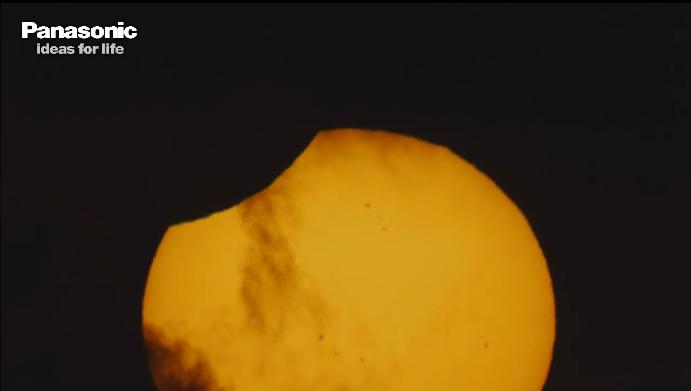
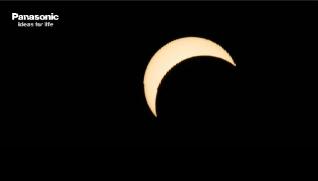
I took screenshots from the different angles at various intervals.  The first image was taken seconds after the moon began to cover the sun, which they referred to as "first contact."


And finally, totality - which lasted about a minute and a half.  During totality, animals armed with their sixth sense (read: virtually anything but humans) immediately tap into this new and foreign environment.  They behave differently and make unusual sounds.  Temperatures have been known to drop 20 degrees Fahrenheit lower than mere minutes earlier.


The sun is 390 times further from Earth and 390 times larger than the moon, which is why they appear to be the same size when they are lined up exactly.  Neat how the universe has worked these delightful little things out.


Incredible shots from the first alternate angle:


A third angle:


And finally, a shot taken by the fine folks at NASA:


By sheer coincidence, my newest bucket list addition:

Experience a solar eclipse for real.

Saturday, 13 October 2012

Led Zeppelin


The first five Led Zeppelin albums (through Houses Of The Holy) are beyond legendary, but I feel the later material does not receive nearly enough love.  So I'm going to express some thoughts on the music contained on their last three records, much of which shaped my youth and made me want to create music for the rest of my life.

Physical Graffiti to me is Zeppelin's creative peak.  Trampled Underfoot, Kashmir, In The Light and Ten Years Gone are exquisite compositions.  These tracks reveal a maturity that is hinted at in previous material like Stairway To Heaven and The Rain Song, but they seem to take their craft a step further here.  Older unused songs were thrown in to stretch it to a double album, and some are magical, like The Rover and Down By The Seaside. To me they are the perfect representation of the whole of Zeppelin being far greater than the sum of its parts. There is an element of mystique, a fifth force that united the four of them musically and spiritually, and these two songs best exemplify it. This kind of connection is ever so rare, and only shows up occasionally in even the best of musical collaborations.  The solo acoustic guitar piece, Bron-Yr-Aur, also bears mentioning, having an ethereal quality that most sensible guitarists with 100x better chops than Jimmy Page would kill to embody.

Presence, with the exception of the grand Achilles Last Stand, is a "back to basics" album.  The band return to being a four piece with very little studio trickery.  But it has its flaws.  Robert Plant's voice is chewed from years of drugs and touring, and John Paul Jones is barely involved.  But the songs themselves are great, particularly Nobody's Fault But Mine and Hots On For Nowhere.  Both Page and Plant reveal all in Tea For One.  But the grand champion of Presence is Achilles Last Stand, the last true Zeppelin masterwork in my eyes.  I may even go as far to say it is Page's supreme contribution to the evolution of rock music.

Page was pretty messed up by 1979, so Jones had to take over much of the operation for In Through The Out Door, as evidenced by the new keyboard-driven sound.  In The Evening and I'm Gonna Crawl are great tracks (Page bares his soul in the latter), and Carouselambra is a sensational musical adventure. One may see Carouselambra as what Zeppelin might have built upon in the 80s had they survived.  It's John Paul Jones in exploration mode and Zeppelin is the vehicle. He's searching. And finding. Finding wondrous things.  And who can't love the groove of Fool In The Rain?   This record is undoubtedly John Bonham at his peak.  But I see much of the record as being largely un-Zeppelin.  Many would argue that Zeppelin died after the 77 tour when Plant's son suddenly died. Plant was never the same.  It's a miracle they even managed to make one more record.

I'll be seeing the Zeppelin movie from the 2007 reunion gig next week, and I'm sure I'm going to love it. But it's not Zeppelin. It's not even 3/4 of Zeppelin. It is far, far less. But it's the closest 20,000 people ever got to seeing Zeppelin again, and I can't possibly express how envious I am of every one of those lucky people who got to see the greatest band of the 70s for one last time.

Except perhaps Paris Hilton.  That leaves me with befuddlement more than envy.

Tuesday, 15 May 2012

Life After People


This is one of the best documentaries ever produced.

A realistic, in depth, scientifically-informed look at how the natural world would react to our species extinguishing ourselves.


The Chernobyl disaster is cited as an example of how nature replenishes itself in an area where humans no longer have an influence.  It was a powerful reminder of how nature will always prevail.  In every instance of this film, it does precisely that - and from day one.

The idea that I am so utterly and wholly insignificant is a refreshing, humbling, and completely necessary thought in this day and age when we humans have become ever so convinced that we are the superior species.  We most certainly have never been, and never will be.  The planet existed for billions of years before us, and it will exist for billions of years after us.

This film leaves me feeling encouraged, and with pure unadulterated joy.

Sunday, 26 February 2012

The best 30 Queen songs


In all my years of being a fan of music, I've never actually compiled lists of my favourite records or songs.  I don't listen to Queen as much as I used to, but they were my real first love in music (except perhaps Max Webster), and I know their extended catalog very well, so they're a logical place for me to start.

In making such lists, fans tend to axe the hits due to their over-exposure in favour of tracks they see as under-recognized. I just wanted to find that happy medium, somewhere between the fan who can't see the bigger picture and the jerk critic who has been in the picture for far too long.

So here goes - a countdown of the best 30 Queen tracks:


30. '39 - a densely layered track, Brian May's supreme statement connecting his two biggest loves, astronomy and music.
29. A Kind Of Magic - a huge worldwide hit, one of the best tracks Roger Taylor wrote for Queen
28. White Queen - one of the strongest early Queen tracks, sheer musical bliss for the last minute
27. I Was Born To Love You - Brian, Roger and John bring life to a Freddie solo track for the final Queen album
26. A Winter's Tale - Mercury's last composition, solemnly envisioning a seasonal snapshot he would never see again
25. Radio Ga Ga - Roger Taylor's answer to Video Killed The Radio Star
24. It's Late - one of Brian May's best and most revealing tracks
23. The Millionaire Waltz - a genre-crossing suite, one of Mercury's greatest achievements
22. Good Company - Brian May's ode to skiffle and big band, including a brilliant guitar orchestration emulating brass and woodwind instruments in the Dixieland style
21. Love Of My Life - undoubtedly Mercury's finest ballad
20. Stone Cold Crazy - proof that Queen were pioneers of speed metal alongside Deep Purple and Black Sabbath
19. Fairy Feller's Master Stroke - as close to progressive rock as Queen would ever get
18. It's A Hard Life - one of the few 80s tracks comparable to their 70s musical depth
17. The Miracle - brilliant arrangement, and unabashed optimism from Mercury despite facing his mortality
16. Keep Yourself Alive - the opening track on the opening album, debuting a unique sound for the 70s
15. Under Pressure - Queen and Bowie spontaneously unite to create a classic
14. Bicycle Race - silliness on the surface, very complex underneath
13. My Fairy King - the first hints of Freddie being a brilliant composer and arranger
12. Liar - the first epic Queen song
11. Crazy Little Thing Called Love - 50s-inspired exercise in pop minimalism
10. Seven Seas Of Rhye - first chart entry, Queen's first big exposure
9. Innuendo - the last epic Queen song
8. The Show Must Go On - seen as Freddie's swan song, looking death in the eye with grace and grandiosity
7. The March Of The Black Queen - the predecessor to Bohemian Rhapsody
6. Another One Bites The Dust - Queen's biggest US hit, crossing over to black radio stations and charts
5. Don't Stop Me Now - Freddie's joyful and timeless classic on self-indulgence
4. Killer Queen - first big hit, the first time they made their unique sound completely accessible
3. Somebody To Love - Aretha-inspired pop gospel perfection
2. We Will Rock You / We Are The Champions - iconic, period.
1. Bohemian Rhapsody - beyond all doubt, the most enduring Queen track of all time, encompassing every one of their trademarks

Tuesday, 6 September 2011

Yes


Yes is not merely a band - they are a force of nature.  They have had about a dozen lineups, each of which have created some wonderful music.  I'd even argue that much of it is spiritually fulfilling art.  Albums like Fragile and Relayer solidified them as the progressive rock giants.  Close To The Edge is my all-time favourite prog album, and I might as well call it scripture.  Going For The One is often lost in the mix, but as far as I'm concerned it is the most aesthetically gorgeous album they ever recorded.  All essential listening for anyone even remotely interested in either rock or classical music.  These records merged the aforementioned two previously incompatible worlds of music together like no other.

The big 70s Yes hit, Roundabout, spawned no less than a thousand prog rock bands who tried to match it, but most of them failed miserably to come even close.  Plenty of them had Yes' technical chops, but they lacked the one key element that virtually every moment of 70s Yes music had - melody.  At any given moment, the melody was always at the forefront, which is what made them the most accessible of all the progressive bands.  By the 80s they shifted gears to focus more on the rhythmical element of their sound to remain relevant in the MTV age, but by the 90s they combined their melodic and rhythmic sides to create great records like Talk, Keystudio and The Ladder.

Their most recent record, Fly From Here, released just a few months ago, more or less returned to the 1980 lineup of the band that included The Buggles.  A very audacious record, it's kind of like Drama meets Close To The Edge.  Even as a big Yes fan, I was very surprised that the record is this good.  Had I not known the history, I'd be thinking I'm listening to a band of guys in their 20s - hungry, wanting to conquer the world, and making their mark on the evolution of music.

I've been fortunate enough to see Yes and its various solo members on about a half-dozen occasions, each a memorable and musically powerful experience.  Jon Anderson carries a one-man show like no other.  Watching him sing Steve Howe's guitar solo at the end of Starship Trooper simply defies words.  And I've seen Steve Howe too.  His gentle touch playing Jon Anderson's melodies on a piece like To Be Over is an equally mesmerizing experience.

Many Yes fans begrudge the fact that they are creating music without Jon Anderson, but what they fail to realize is that Yes is bigger than any single person.  They have created great records without Steve Howe, without Rick Wakeman, and without Jon Anderson.  Decades from now when they will all have passed, I can see the name Yes enduring with a completely new set of musicians with a similar musical vision.  Kind of like the way Bach still exists.  It is a sound, a presence, a musical ideology that is timeless.  People will be listening to Close To The Edge a century from now, the same way we listen to Vivaldi and Chopin today.  Most things will fall by the wayside, but Yes will be heard in many a musical time capsule.

And hopefully the sound will be built upon by others.  Bands like Dream Theater, The Flower Kings, and Porcupine Tree have already begun.

Thursday, 1 September 2011

Sleepwalking toward our 2020 climate targets

Today's Toronto Star contained a pretty grim-looking article, which should be essential reading for every Canadian citizen:

http://www.thestar.com/opinion/editorialopinion/article/1047635--sleepwalking-toward-our-2020-climate-targets


Some people will read it with interest, and most will go on as if nothing is really wrong.  After all, the sun will still rise tomorrow, right?

I'd like to make my first blog post not a whine session, but rather a call to action.  There are two types of people - complainers and doers.  But people need to know why to do, and that must almost always be a result of some kind of complaining.  But it's all about where we choose to focus the majority of our energy.

I think it's fair to say that most people in Canada are apathetic of any issues beyond paying their own bills.  And with good reason - the middle class is shrinking before our very eyes.  The days of going to school to get your piece of paper and having a job handed to you are long over.  Big business is regularly given tax cuts that are said to create jobs and stimulate the economy, but anyone watching carefully enough knows the biggest corporations are laughing all the way to the bank and outsourcing the jobs to countries with little (or non-existent) labour laws.  Before the last election, one of Canada's political parties suggested an incentive for companies to create jobs here - pay them a dividend AFTER the job is created, not before.  I'll give you a clue - this party has never been in power on the federal level before, although they've almost always left surpluses on the provincial level.

Plenty of people live by this so-called "golden rule" - never talk about politics or religion.  But if we all did that, the earth would still be flat and we'd all be reading the bible as non-fiction.  We NEED to talk about these things, as it's the only way any kind of forward momentum can happen.  By making these subjects a common part of our discourse, only then will we learn from each other and realize what our collective needs and goals are.  The emphasis on the individual and our singular need to accumulate money and material things has eroded away our biological need for the group.  I wonder what it is going to take for us to rediscover this basic need of ours?

People are talking about it in virtually all corners of the world.  It's kind of like the Bahai faith - in small numbers, but widespread.

Feeling cautiously optimistic.